Well, today I’d planned to proceed to the next bunny behavior list item and discuss pooping. Which is quite an important bunny activity, as we shall see! However, today continues the very busy trend of this entire week, so I’ll have to delay this critical topic till later…
On today’s menu for me: working on dissertation, trying to get to Titusville and fight traffic for STS-134 launch (final launch of Endeavour) (well, the launch was apparently scrubbed, so that means more time to work on dissertation stuff), then proceeding to downtown Orlando (fighting more traffic) for opera this evening (La Boheme).
On today’s menu for Noe: snack of lettuce, a long nap, then dinner of timothy pellets followed by orchard grass hay, then a nice forehead rub from humans.
I can already tell who will have the more relaxing day!
While Noe has a few favorite places to nap, she’ll pretty much nap anywhere. Her favorites currently are on a chair under the dining room table and under a chair on the porch. Lately, she’s been crawling between the side of the bed and the blanket that drapes over it down to the floor, and napping there. Though that has to get pretty hot for her.
Like cats, rabbits can nap pretty much anywhere.
Wild rabbits are most active at dawn and dusk, and those are also Noe’s preferred active times. But she can also be up and around during the day and after dark, especially if we’re doing things that suggest there’s even the remotest chance she might get a snack (like walking to the kitchen). The rest of the time, she naps.
The bathroom floor is conveniently located next to her hay bin.
Rabbits do sometimes sleep with their eyes open- they’re alert little critters. Noe will often nap with her back to a wall, so she has a good view (though her sense of hearing is more important) of the room. She also likes sleeping in doorways, so she can keep an ear to each room.
Extreme velvety nose close-up!
Probably the cutest thing she does is go into REM sleep and dream. Her nose and whiskers start twitching, her ears move back and forth, and she makes little chewing motions. She’s usually in “loaf mode” when she does this, so we don’t see paw twitching like sleeping dogs have. But it’s still very cute.
We don’t have good bunny dreaming videos, so here’s a random one from YouTube. Use it for a Friday moment of relaxation.
An interesting article posted yesterday at Mother Jones looks at the psychological research behind why we often believe information that agrees with our previously held beliefs, and reject information that challenges those beliefs. The article, by Chris Mooney, builds on the psychological theory of “motivated reasoning:”
The theory of motivated reasoning builds on a key insight of modern neuroscience: Reasoning is actually suffused with emotion (or what researchers often call “affect”). Not only are the two inseparable, but our positive or negative feelings about people, things, and ideas arise much more rapidly than our conscious thoughts, in a matter of milliseconds—fast enough to detect with an EEG device, but long before we’re aware of it. That shouldn’t be surprising: Evolution required us to react very quickly to stimuli in our environment. It’s a “basic human survival skill,” explains political scientist Arthur Lupia of the University of Michigan. We push threatening information away; we pull friendly information close. We apply fight-or-flight reflexes not only to predators, but to data itself.
We’re not driven only by emotions, of course—we also reason, deliberate. But reasoning comes later, works slower—and even then, it doesn’t take place in an emotional vacuum. Rather, our quick-fire emotions can set us on a course of thinking that’s highly biased, especially on topics we care a great deal about.
What’s interesting (and disturbing) is that, for scientific issues that are deeply tied to our sense of identity, education based on evidence actually often makes us less likely to believe the evidence:
…one insidious aspect of motivated reasoning is that political sophisticates are prone to be more biased than those who know less about the issues. “People who have a dislike of some policy—for example, abortion—if they’re unsophisticated they can just reject it out of hand,” says Lodge. “But if they’re sophisticated, they can go one step further and start coming up with counterarguments.” These individuals are just as emotionally driven and biased as the rest of us, but they’re able to generate more and better reasons to explain why they’re right—and so their minds become harder to change.
While the article focuses on science, there are political and ethical implications of this article as well. It’s a good introduction to this active area of research, with timely examples. Check it out!
Every year around the US, creationists try to pass bills in state Legislatures either limiting discussion of evolution in classrooms or promoting a strategy called “teaching the controversy.” The latter approach essentially requires science teachers to teach students about both the scientific evidence for evolution and religiously-based philosophy that claims that evolution does not exist (or, alternatively, that some aspects of evolution have occurred, but not others).
Evolution is a fact, backed up by copious amounts of evidence. Natural selection, the modern theory describing how evolution happens, is probably about as well-supported as other scientific theories you may have heard about, such as the theory of gravity or cell theory. Some details of the theory of natural selection are currently being fleshed-out by scientists- a normal and healthy part of the scientific process. There is no debate, however, that natural selection is the best explanation we have today to explain the evidence for evolution that we see all around us. Philosophy and religion can offer no better, evidence-based, explanation of how evolution occurs.
This year, Florida Senate Bill 1854 would require “a thorough presentation and critical analysis of the scientific theory of evolution.” Sounds reasonable, right? Well, Florida State Science standards already require critical discussion in the science classroom. It turns out that the sponsor of this bill, Senator Stephen Wise, sponsored a bill in 2009 that advocated a “teach the controversy” approach to evolution. That bill failed, so he’s apparently trying to sneak religion into science classrooms again this year.
What does Sen. Wise suggest is a good “critical” alternative to evolution? He won’t say. In interviews by reporters, he calls it “non-evolution” or a “theory of whatever.” (In 2009, he called for teaching “intelligent design,” a Christianity-based philosophy which has legally been ruled religion, not science.) If this bill passes, Florida will be opened up to lawsuits similar to those that have cost other states quite a bit of money. It will also presumably have a chilling effect on the state’s efforts to attract high-tech businesses, such as medical research. Perhaps most importantly, it will teach our students something that just isn’t true. Evolution has occurred, and is occurring, and natural selection is the best explanation we have based on the evidence we have.
Floridians! If the prospect of poor science education, revenue-draining lawsuits, and general philosophical confusion bothers you, then you can sign this petition! One useful feature is that this petition sends an e-mail to your state legislatures when you sign, which helps make a greater impact. Non-Floridians can sign too, but the signatures of FL residents will have greater impact. I also urge you to add comments, as well as just signing. And, pass this on!
Sadly, I do not have any photos of Noe frolicking behavior. We didn’t take many photos of it when she was young, and now that she’s older her nutty bounding around has definitely tapered off. Luckily, there are plenty of frolicking bunny videos on YouTube… though I’m not sure why so many of them have soundtracks attached. (Edit to add: you’ll have to click through to YouTube to watch this video, apparently b/c of the soundtrack.)
Bunny frolicking includes mad dashing around, head tossing, and “binkys”- those laps and flips you see in the video. Young rabbits can keep up this sort of thing for a while, but nowadays Noe will generally do a few laps around a room, toss a few half-binkys in there, and then lay down to rest. It is pretty cool that she’s almost 9 and still doing this sort of thing!
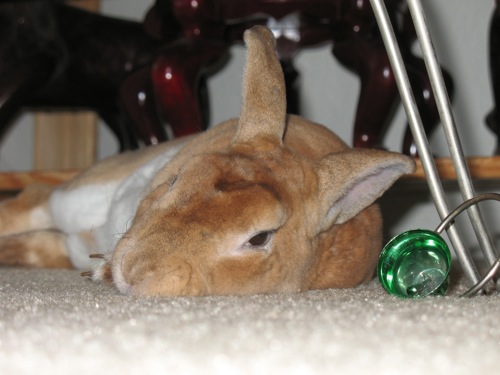
I guess playing with toys also fits into the “frolicking” category. I do have a photo of her napping after playing with one of her ring toys. (Trust me, I will have plenty of photos for next week’s “napping” post.) So, here is Noe post-frolic:
Yes, we did clip her nails after looking at this photo...
Digital tools can help us understand bird migration. How so?
Many animals take seasonal long-distance migrations- this is especially evident for birds. For many bird species- including raptors, songbirds, wading birds, and seabirds- the reproductive benefits of migrating thousands of miles from summer breeding grounds to winter feeding grounds outweigh the costs of such a difficult journey. Therefore, natural selection has resulted in massive large-scale migrations of these animals.
Flying cross-country is MUCH harder than the slingshot mode of transportation... (Image: rovio.com)
Migration usually takes place twice a year, as you might expect: in spring (to summer breeding grounds) and in the autumn (to winter feeding grounds). While different species, and even different populations within species, have different migration routes, there are several known migration corridors or “flyways” that are traveled by many species. Flyways are determined partly by the relative north-south positions of the feeding and breeding grounds, and partly by prevailing wind patterns, geography, and habitat along the way.
In North America, there are three major flyways, as seen on the map below. Now think about a tiny warbler or sparrow making this journey from, say, Ontario. It requires an enormous amount of effort just to cross the United Sates- and then you reach the Gulf of Mexico! While some birds cut straight across the Gulf (remember- these are forest birds, so can’t stop and swim for shore), others head south via Florida or along the Mexican coast.
Major North American flyways (Image: borealbirds.org).
Other birds have even longer migrations. This map shows the migratory routes of several species who breed in the Arctic. Again, keep in mind that birds who fly over the Pacific have very few spots to land. Many, many birds get exhausted and literally drop dead along the way. Clearly, migration is a hazardous proposition.
Migration patterns of Arctic birds (Image: arctic.fws.gov)
The process of understanding migration routes has been quite complex. We can record when birds arrive at and then leave a specific site (phenology), but that doesn’t tell us where individual birds are coming from and going to, unless the birds are banded or being tracked by radio telemetry. Both of these types of research are very labor-intensive. However, now there are new digital tools that let both casual and hardcore amateur birdwatchers help in this effort.
One example is eBird, an online database that compiles bird observations, and which is then used by ornithologists to study bird distributions. This type of crowdsourcing also helps enthusiastic birders participate in science research. One recent addition to eBird’s website is a set of animated maps showing migration patterns for several species.
Animated GIF of Chestnut-Sided Warbler migration (ebird.org)
These maps are limited to the contiguous U.S., so hopefully they’re working on ways to expand them to show a wider area. Migratory birds certainly aren’t restricted by human borders, and these maps would be a great tool to show that.
Another digital tool that helps understand bird migrations is quite different- radar! Apparently, the number of migrating birds during peak migration is so large that flocks of birds can be picked up on radar. It takes a keen eye to differentiate the radar patterns birds make from weather phenomena, but this tool is being explored as a way to track migration patterns.
Tracking birds with radar: April 12-13, 2011. (Image: badbirdz2.wordpress.com)
Radar can show us how birds are affected by weather systems and which locations birds are stopping in. This information could obviously be a great resource for birders- if you know that birds traveled to the SE coast of Florida last night, you could get up this morning and head over to birding spots on the coast. This seems like a pretty interesting tool to use for understanding birds.
Will adding digital tools to more traditional on-the-ground ways to measure bird migration help us understand birds better? Will these tools excite a new generation of potential birdwatchers? Non-digital citizen science projects are already showing us the effects of global warming on bird migration. If these projects have a larger scope and interest a bigger segment of the population, they might be able to accomplish quite a lot. And they’ll teach us more about birds than that they really, really hate those self-satisfied pigs.
Fore more information or to participate in these efforts, check out these sites:
Earlier this week, I attended a conference of the National Association of Research in Science Teaching. I wasn’t presenting anything (missed the submission deadline), but it turned out to be fairly worthwhile. I ended up only attending two days of the conference, and focusing primarily on the digital tools/informal science sessions. I did get the chance to chat with a few people about my work and make some connections, which is always nice.
Here are just a few impressions from the conference.
The digital media tools used for science education seemed to mainly fall into two categories: simulations for teaching science concepts, and simulations for assessment purposes. (This is probably not a very profound observation.) The former seems to be the more ‘traditional’ tools, e.g., using racing games or pinball-esque scenarios to teach about physics. The latter are newer to me, at least, and are significant in that they represent an attempt to get away from multiple-choice tests for testing inquiry. There were some neat ideas from both these general categories.
The digital tools for informal learning were more wide-ranging, which you’d expect. There were some cool demos here; two I found interesting were FoldIt (which turns protein-folding problems into crowdsourced puzzle games) and Dancing the Earth (which uses a mixed-reality simulation to teach astronomy concepts).
The session that was probably most useful for me immediately was one on problems in teaching evolution. Some of the bigger conceptual issues raised here were: the challenge of linking evolutionary processes at different scales (e.g., population dynamics & speciation), teaching students to differentiate between useful and non-useful types of evidence, and difficulties with reading phylogenetic trees.
I also went to a session on philosophy of science, objectivity, and teaching about pseudoscience. Some of the ideas from this session would be useful if I ever did teach science again, since it was more geared toward educators. One presentation in particular stands out, on the subject of teaching science in communities which place a high level of emphasis on traditional ecological knowledge. The presenter tried to lay out a strategy that charts a middle course between immediate rejection or fuzzy acceptance of TEK, by focusing on talking about cultural technologies, rather than immediately comparing philosophies. The idea seems to be to focus on areas where there’s common ground (i.e., observation, testing, and building technologies in both traditional cultures and science), rather than immediately alienating students by dismissing their culture or dismissing science as a specialized way of understanding the world. This is an interesting idea to think about.
Finally, trying to present via Skype is just asking for trouble. I attended one session (a digital media session, naturally) in which two presenters were going to present via Skype. Even though everything was clearly set up and working during the break before the session, when it came time to present, something went wrong with the sound on someone’s end. The two presenters ended up being able to give their talks, after much technical tweaking, but this did not go smoothly.
Via Jessica Palmer, here’s an interesting project: a multimedia essay on ecological mythos, Romanticism and 19th-Century science, filmmaking, and Middle-Earth.
It’s called The Mythoecology of Middle-earth: A report from the Shire, a landscape born of high fantasy, natural science, and geek tourism, by Peter Nowogrodzki, and it’s a virtual cabinet of curiosity (or confection, as Tufte would say) inviting readers to explore connections between natural history, travel, and mythology:
In the century before Tolkien’s birth, the study of nature itself had become the subject of ardent imaginative exploration: The Age of Discovery’s there-and-back conquests uncovered troves of biological data, fodder for the Age of Wonder, in which “Romantic science” strived to imitate poetry—not just describing nature but transforming the world by fundamentally altering our perception of it.
It has birds (eagles, giant: real and mythical), trees (as illustrated by Haeckel, Blake, and the Weta Workshop), meditations on the virtual and the mythology of filmmaking, demands by Maori for respect for indigenous landscapes and by labor unions for better pay.
I’m not sure it has a point, but it creates some interesting juxtapositions.
Continuing our series on bunny behavior today- let’s start by looking at the Noe behavior list:
gnawing
eating
exploring
frolicking
napping
pooping
digging
getting the humans’ attention
warning the humans of danger
Looks like we’re up to #3: exploring.
Rabbits are intensely curious creatures. They have poor vision (except for movement), and it seems like this translates into an obsessive need to investigate their surroundings, to see if anything has moved and will become an obstacle in case of the need to escape from raptor attack. While the chance of raptor attack in our apartment is pretty slim, Noe did spend two days with a cockatiel once, so perhaps that heightened her keen instinctual awareness of danger from above (I also hear that the cockatiel was fairly pouty after her bunny-visiting experience, but that’s another story).
So Noe explores. She generally checks her usual escape routes once a day, but when a new object appears, this warrants further investigation.
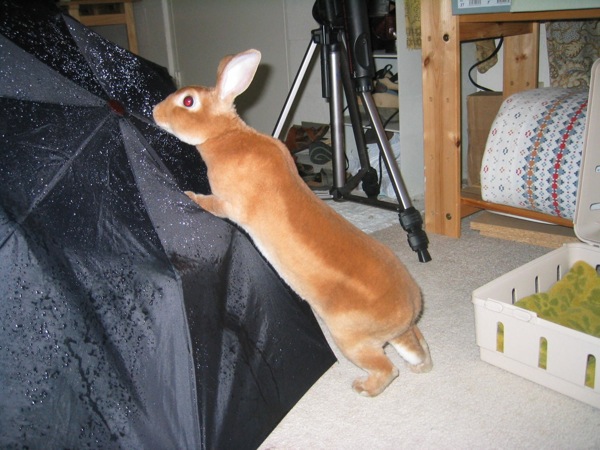
Adolescent bunny's first encounter with umbrella.
And there are certain places that she usually has no access to that always warrant investigation. Namely, closets, cupboards, and the laundry room.
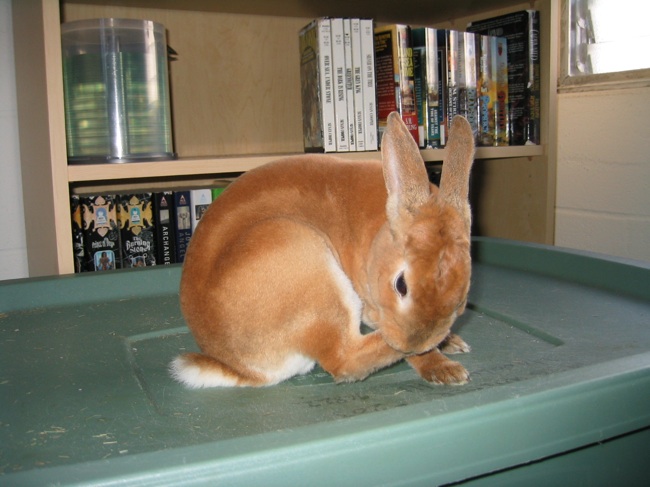
What's this, then?
She has a routine in the laundry room. Whenever we open the door and she’s nearby, she’ll make a beeline for the doorway. If her way is clear (no feet or laundry baskets in the way), she’ll then hop behind the washing machine. Usually, she’ll make a circuit around the machine, then come out. However, if we’re already calling her to come out, she’ll stay behind the machine, just sitting there, until we poke her to get her to leave. If we give up and don’t call her, she will often come out on her own, thump to get our attention, then scamper back behind the machine again. This is obviously a bunny game.